By Will Bower
Assistant professor Naomi Rodgers and PhD student Julia Kerrigan of the Department of Communication Sciences and Disorders (CSD) in the College of Liberal Arts and Sciences recently traveled to Oxford, UK, for the Oxford Stuttering and Cluttering Research Conference. Both presented work at the conference, including a talk and poster projects.
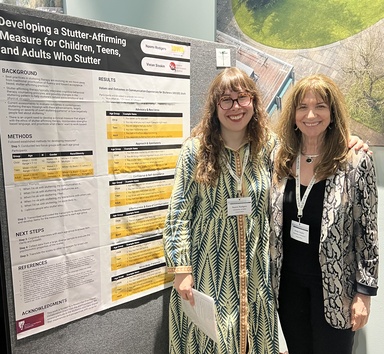
Rodgers presented two posters and delivered a talk titled, “Organizing life around stuttering: Markers of the stuttering experience as complex trauma,” which examined how adults can experience trauma related to stuttering.
Rodgers said she came back to the United States with fresh perspectives and new ideas.
“The field of stuttering is quite small,” Rodgers said. “Because the attendees are people who know a lot about stuttering, the discussions at talks and meals were deeply informed and nuanced.”
Beyond drawing inspiration, Rodgers said the focus on cultural relevance and understanding stood out to her.
“While stuttering may look similar on the surface across contexts, how it is understood and how it is experienced can differ widely across cultures,” Rodgers said. “Hearing how researchers and speech-language pathologists work within different linguistic, educational, and sociopolitical systems pushed me to reflect more critically on assumptions we sometimes take for granted in research.”
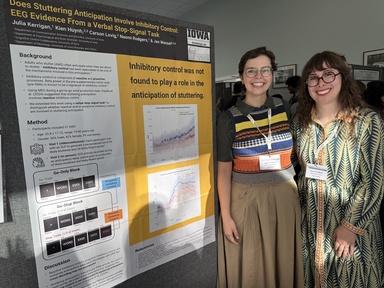
PhD student Julia Kerrigan presented a poster titled, “Does Stuttering Anticipation Involve Inhibitory Control? EEG evidence from a verbal stop-signal task.” She said that while Oxford was her first international audience, she had already practiced the presentation several times.
“I felt confident about imparting our study,” Kerrigan said. “I also received lots of questions while presenting that got me thinking deeper about our findings and how we'll proceed in study two.”
Kerrigan said she appreciated the opportunity to connect with stuttering researchers from across the world.
“Having connections with my peers outside of the United States lets me expand my ideas about ways we can further stuttering research and destigmatize stuttering within our respective cultures and communities,” Kerrigan said. “They are also great people that I just love to chat with over meals.”