By Samantha Wirth
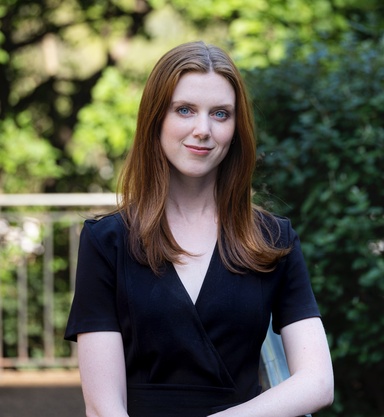
Sharice Clough, PhD, CCC-SLP, began her journey at the University of Iowa in 2015 when she started a master's degree in speech-language pathology. She later pursued a PhD in hearing and speech sciences from Vanderbilt University and completed interdisciplinary post-doctoral training at the world-renowned Max Planck Institute for Psycholinguistics in Nijmegen, The Netherlands.
Clough’s research focuses on neurogenic communication disorders, which occur when there is damage to the brain. These disorders can affect one’s ability to produce or understand language. Disorders such as strokes, traumatic brain injuries, and Alzheimer’s disease can impact functions such as speaking, listening, reading, writing, memory, attention, and processing speed.
Because changes in these functions can heavily impact how individuals are able to communicate in everyday life, Clough’s research focuses on the intersection of neurogenic communication disorders and real-world communication.
“Communication is multimodal, meaning that it's made up of not only auditory information like spoken words and prosody, but also rich visual language signals like gestures, eye gaze, and facial expressions to convey meaning,” Clough said. “It is also interactive, which requires rapid turn-taking and flexibility in conversations, and is situationally based on context.”
In her research, Clough aims to capture all three of these dimensions through controlled behavioral experiments, which can illustrate how individuals use and process multimodal language across different communication settings.
“By leveraging technology like motion tracking, eye-tracking, and virtual reality, we can study multimodal language in rich and realistic environments while maintaining strong experimental control,” Clough said. “This can lead to more sensitive and ecologically valid language assessments and treatments for individuals that better reflect the cognitive and social demands of daily life.”
Returning to CSD as an educator and researcher
Clough’s passion for research aligns with her commitment to teaching and mentorship. As an Iowa graduate, returning to the campus as an instructor holds both personal and professional significance.
“I had many formative experiences at Iowa and grew a lot both personally and professionally,” Clough said. “The clients I worked with as a student clinician had a profound impact on my life and taught me a lot about how important communication and connection are for everyone.”
As a former student, Clough knows the quality of the CSD clinical and research environments firsthand. Now, as an instructor, she’s excited to now be the person training new generations of speech-language pathologists to understand the complex communication needs that they will encounter in their careers.
At Iowa, Clough also plans to launch her own research lab. The BLOOM Lab, which stands for Brain, Long-term Outcomes, and Multimodal language, will focus particularly on studying multimodal language comprehension and production in individuals with traumatic brain injuries (TBIs). Her research program aims to better understand the cognitive and neural resources that support multimodal language and better predict and improve long-term outcomes for individuals living with TBIs.
“TBIs are unfortunately very common, with over two million people sustaining a TBI each year in the United States,” Clough said. “These injuries can occur at any point in the lifespan and look different for every individual.”
One of her long-term goals is to develop a large-scale brain injury patient registry, allowing researchers to study as many individuals with TBI as possible and over long periods of time. By analyzing individuals through neuropsychological testing, experimental measures, and neuroimaging, Clough and other researchers can identify predictors of functional outcomes and recovery.
“This approach is modeled after the Iowa Neurological Patient Registry that was pioneered at the University of Iowa,” Clough said. “With this successful track record in large-scale patient registries and access to a level one trauma center, Iowa is the perfect place to extend this research method to individuals with TBIs.”
Through her research, teaching, and clinical focus, Clough hopes to use her role at CSD to further the understanding and treatment of neurogenic communication disorders, making an impact in the city where she began her education.
“I’m looking forward to being back in Iowa City and having the opportunity to create new memories here as I start the next chapter of my career,” Clough said.