By Samantha Wirth
For Madelynn Williams-Kane, her efforts in both community engagement and academic research reflect her commitment to making sure that children with hearing loss receive support that is technically appropriate on paper, as well as meaningful in everyday life.
Williams-Kane is a graduate clinician in the Speech, Hearing, and Language Clinic, as well as a second year Doctor of Audiology (AuD) student in the Department of Communication Sciences and Disorders (CSD) in the College of Liberal Arts and Sciences.
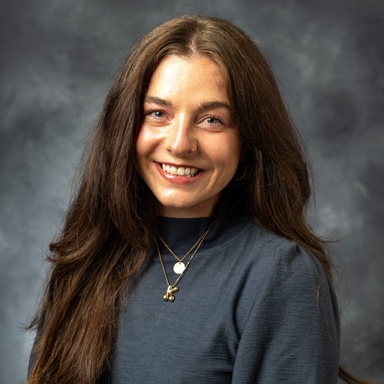
Inspired by her personal experiences as an individual with hearing loss and her time spent teaching children who are D/deaf, Williams-Kane aspires to combine academic scholarship with community impact to create meaningful connections. This community-focused scholarship allowed her to be recognized by the Office of the Vice President for Research’s 2026 Dare to Discover campaign, which highlights impactful University of Iowa students and postdoctoral researchers, scholars, and creators on banners across downtown Iowa City.
Through collaborations with local businesses and organizations such as Wilson’s Orchard & Farm and the Iowa Children’s Museum, Williams-Kane plans welcoming events and seasonal gatherings for children with hearing loss and their families. These events not only provide friendship-building opportunities for children with hearing loss, but they also give their parents the ability to create community.
“These gatherings aim to reduce isolation, strengthen parent-to-parent support networks, and create spaces in which children can interact with peers who share similar experiences,” Williams-Kane said. “Hosting events in collaboration with local Iowa City businesses also strengthens the ties between the D/deaf community and the broader community.”
Williams-Kane's passion for youth-focused initiatives carries into her research, where she analyzes the effectiveness of existing Individualized Education Programs (IEPs) for children with hearing loss—determining whether they are truly corresponding to a child’s individual needs. By analyzing IEP goals, coding them across developmental domains, and comparing them to standardized testing results, Williams-Kane determines if existing educational planning aligns with a student's documented areas of weakness.
Through her research, Williams-Kane has found a large amount of variation in how IEPs are written regionally and across service models. “In many cases, broader academic goals are included, but foundational linguistic domains such as grammar and pragmatic language may be underrepresented despite persistent challenges in those areas for children with hearing loss,” she said. “This raises important questions about how audiological data, speech-language assessments, and educational planning are integrated in school systems.”
Ultimately, her research seeks to strengthen relationships among audiologists, speech-language pathologists, educators, and families. Williams-Kane hopes that this will inspire more interdisciplinary collaboration across these groups and professions, leading to educational plans that meaningfully reflect the real-world communication needs of students.